Why Alpha May Matter More Than We Think for Sleep
PISCATAWAY, New Jersey, September 14, 2026 --- Slow breathing is often discussed as a way to help the body settle before sleep. But an equally interesting question is what happens in the brain at the same time — especially to Alpha activity.
Alpha brain waves are usually discussed in the roughly 8–13 Hz range and are strongly associated with quiet wakefulness, relaxed attention, and the transition away from active external processing. Alpha activity also changes as the brain approaches sleep.
That matters because breathing may not be acting alone.
Research has shown that rhythmic visual and auditory stimulation in the Alpha range can produce short-term changes in Alpha-band brain activity. A 2023 review in Biomedicines found evidence that visual, auditory, and audiovisual stimulation can influence Alpha oscillations, although responses differ across people, protocols, and experimental conditions.
Read the 2023 review on PubMed
The sleep connection is especially interesting.
In a randomized crossover study of adults who took more than 30 minutes to fall asleep, researchers timed brief auditory pulses to each participant’s ongoing Alpha oscillations. Among the participants included in the analysis, average sleep-onset latency was reduced by about 10.5 minutes during the stimulation condition compared with sham.
That does not mean Alpha stimulation is a proven treatment for insomnia. But it does suggest that the timing of stimulation relative to a person’s own Alpha rhythm can matter.
Read the sleep-onset study on PubMed
A separate 2024 study reported that closed-loop auditory stimulation could alter Alpha power, frequency, and connectivity in a phase-dependent way, while also affecting sleep-onset dynamics.
Read the closed-loop Alpha study on PubMed
An overview from Allergy Research Group also discusses the relationship among Alpha activity, relaxation, and sleep, including the role of slow rhythmic breathing in creating conditions associated with a calmer brain state.
Read the Alpha and sleep overview
The important point is not that everyone should use the same 10 Hz signal.
If anything, the research raises the opposite possibility: Alpha may need to be considered individually.
People differ in their Alpha frequency, Alpha dynamics, and response to rhythmic stimulation. That may help explain why the same sound, breathing pattern, or relaxation exercise can feel deeply settling to one person and much less effective to another.
Twinloop, developed by Twinloop Innovations Inc., is built around that idea.
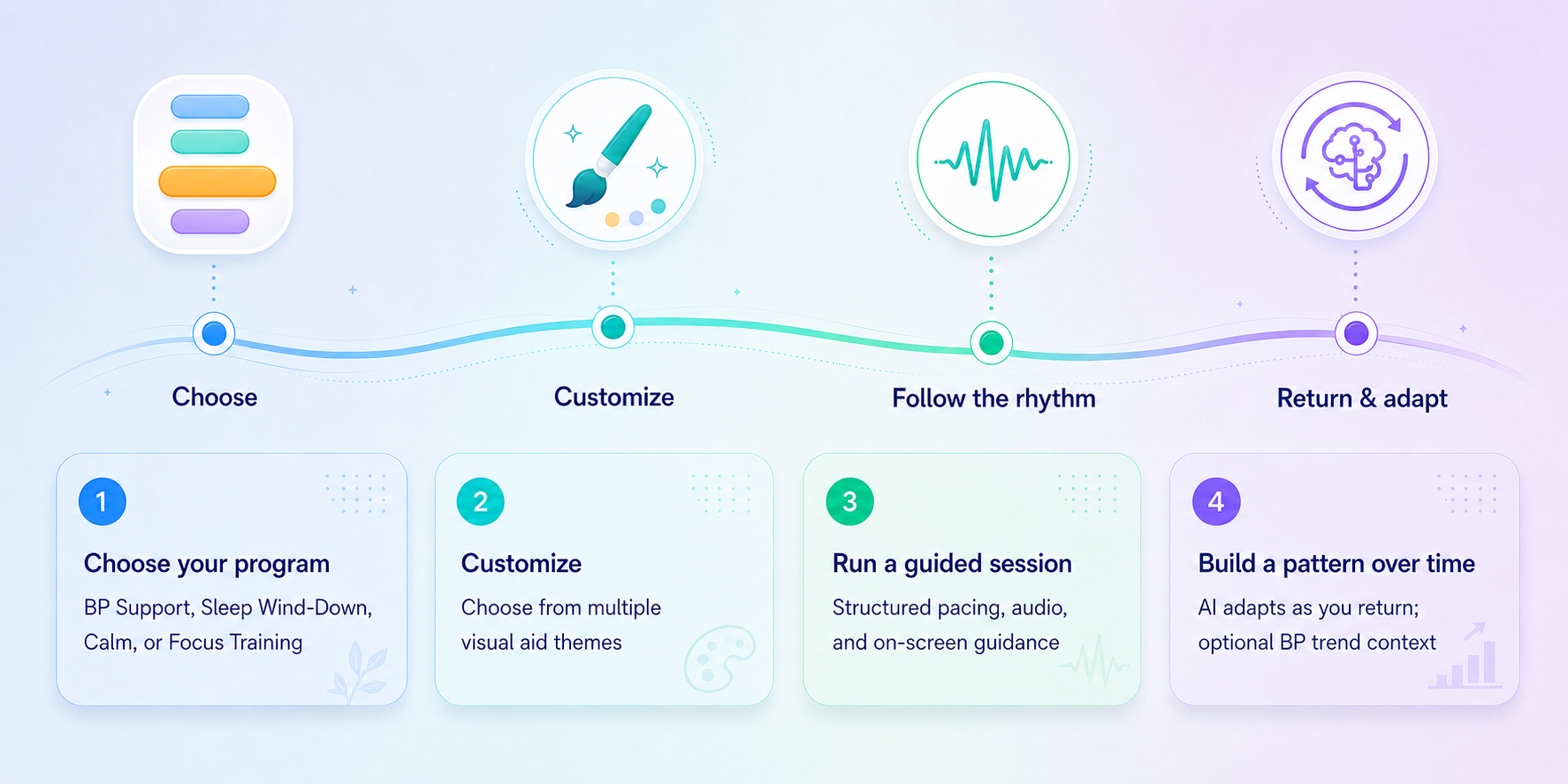
Twinloop does not measure EEG. Its sensorless personalization estimates an Alpha starting frequency and combines Alpha-paced visual or auditory cues with an individualized breathing rhythm.
The goal is not to force the brain into a particular state. It is to give each person a more relevant place to begin and then learn from how the experience actually feels.
Breathing still matters.
But Alpha may be an important part of explaining why the same breathing exercise does not feel the same to everyone.
Instead of asking only:
“What is the best breathing rate for sleep?”
A more interesting question may be:
“What Alpha rhythm — together with what breathing pace — fits this person best?”
That remains an open research question.
And it is exactly the kind of question worth exploring.
Research Sources
-
Gallina J, Marsicano G, Romei V, Bertini C. Electrophysiological and Behavioral Effects of Alpha-Band Sensory Entrainment: Neural Mechanisms and Clinical Applications. Biomedicines. 2023.
https://pubmed.ncbi.nlm.nih.gov/37239069/ -
Bressler S, Neely R, Yost RM, Wang D. A randomized controlled trial of alpha phase-locked auditory stimulation to treat symptoms of sleep onset insomnia. Scientific Reports. 2024.
https://pubmed.ncbi.nlm.nih.gov/38844793/ -
Hebron H, et al. A closed-loop auditory stimulation approach selectively modulates alpha oscillations and sleep onset dynamics in humans. PLOS Biology. 2024.
https://pubmed.ncbi.nlm.nih.gov/38889194/ -
Hapke K. Alpha Brain Waves for Sleep. Allergy Research Group.
https://allergyresearchgroup.com/blogs/nutrition-in-focus/alpha-brain-waves-for-sleep
About Twinloop Innovations
Twinloop Innovations develops science-informed digital wellness technologies designed to support calm, sleep, blood pressure support, and broader guided training experiences. Learn more at www.twinloop.io and read company updates at www.twinloop.io/news.
Disclaimer: Twinloop products and content are provided for general wellness and informational purposes only and are not a substitute for professional medical advice, diagnosis, or treatment. Users should consult a qualified healthcare professional regarding any medical concerns or decisions.