Beyond 4-7-8: What Research Says About Fixed and Personalized Breathing
PISCATAWAY, New Jersey, September 10, 2026 --- Structured breathing techniques such as 4-7-8 breathing have become widely used because they are simple, memorable, and easy to practice without equipment. The familiar pattern --- inhale for four seconds, hold for seven, and exhale for eight --- provides a clear framework for slowing breathing and directing attention toward the breath.
Clinical research provides some support for 4-7-8 breathing as a relaxation technique. In a randomized study of 90 patients after bariatric surgery, participants who practiced 4-7-8 breathing had lower post-intervention state-anxiety scores than participants assigned to deep breathing or usual care (Kurt Aktaş & Eskici İlgin, 2023).
That finding supports 4-7-8 breathing as a potentially useful relaxation technique in a specific clinical setting. It does not establish the 4-7-8 timing pattern as the best breathing method for every person, every physiological goal, or every situation.
Fixed Breathing Formulas Are Useful, but the Physiology Is More Complex
A 2025 study published in Applied Psychophysiology and Biofeedback directly compared square breathing, 4-7-8 breathing, and two six-breaths-per-minute breathing conditions in 84 participants.
The six-breaths-per-minute conditions produced larger increases in heart-rate variability (HRV) than either square breathing or 4-7-8 breathing during the experiment (Marchant et al., 2025).
The same study found no meaningful differences among the breathing conditions in blood pressure or mood during the brief experimental period, and the six-breaths-per-minute conditions produced mild over-breathing.
The findings therefore do not support replacing 4-7-8 with another universal formula. Instead, they show that different breathing patterns can produce different physiological responses.
Slow Breathing Has Broader Evidence for Autonomic Effects
The scientific evidence for slow voluntary breathing extends well beyond any single named technique.
A 2022 systematic review and meta-analysis evaluated 223 studies of voluntary slow breathing and reported increases in vagally mediated HRV during slow breathing, immediately after a single session, and following multi-session interventions (Laborde et al., 2022).
HRV is influenced by multiple physiological processes and should not be treated as a direct measure of relaxation or health by itself. However, the findings provide evidence that slow breathing can meaningfully influence cardiac autonomic regulation.
This broader literature shifts the scientific question away from whether one memorable counting formula is universally correct and toward how breathing rate, timing, comfort, and individual physiology interact.
Cardiorespiratory Resonance Can Differ Between Individuals
Heart rate and respiration interact through respiratory sinus arrhythmia and the baroreflex. In HRV biofeedback, researchers often assess an individual's cardiorespiratory resonance frequency rather than automatically assigning the same breathing rate to everyone.
A practical resonance-frequency assessment protocol described in Frontiers in Neuroscience commonly evaluates adult breathing rates in the approximate range of 4.5 to 6.5 breaths per minute. The purpose is to identify the rate that produces the strongest convergence of physiological resonance measures for that individual (Shaffer & Meehan, 2020).
This does not mean that every person has one permanently fixed or clinically important "perfect" breathing rate. Resonance-frequency assessment depends on measured physiological signals and specific experimental criteria.
It does show that relevant cardiorespiratory responses can vary between individuals.
That variability provides a scientific rationale for investigating personalized paced breathing rather than assuming that one fixed count should be the default for everyone.
Personalization Is Scientifically Plausible, but Superiority Has Not Been Established
Personalization should be evaluated with the same scientific caution applied to fixed breathing techniques.
A 2026 randomized study published in Scientific Reports compared individually determined resonance-frequency HRV biofeedback with HRV biofeedback at a fixed rate of 0.1 Hz, equivalent to six breaths per minute.
After four weeks, both breathing groups showed reductions in self-reported stress, anxiety, and depressive symptoms relative to the control group. The study did not find a meaningful advantage for individualized resonance-frequency breathing over fixed six-breaths-per-minute breathing (Sumińska, Rynkiewicz & Szulczewski, 2026).
Individualized breathing is physiologically plausible and worth studying, but current evidence does not justify claiming that personalized breathing is universally superior to a well-chosen fixed slow-breathing rate.
What About Breath Holding?
Breath holding is a defining feature of 4-7-8 breathing and several similar techniques. A pause may help some people concentrate on the exercise or experience the pattern as structured and calming.
Current evidence, however, does not establish a seven-second hold, or any single fixed hold duration, as necessary for relaxation or physiologically optimal for all users.
The direct 2025 comparison also demonstrates that substantial HRV responses can occur during slow breathing protocols that do not depend on the 4-7-8 hold structure.
For regular guided breathing practice, comfort and the ability to maintain a smooth, sustainable breathing pattern are important considerations.
The Twinloop Approach: Personalization as a Starting Point
Twinloop, developed by Twinloop Innovations Inc., approaches paced breathing from a different starting question:
Instead of assigning the same breathing formula to everyone, can the initial breathing pace be better matched to the individual?
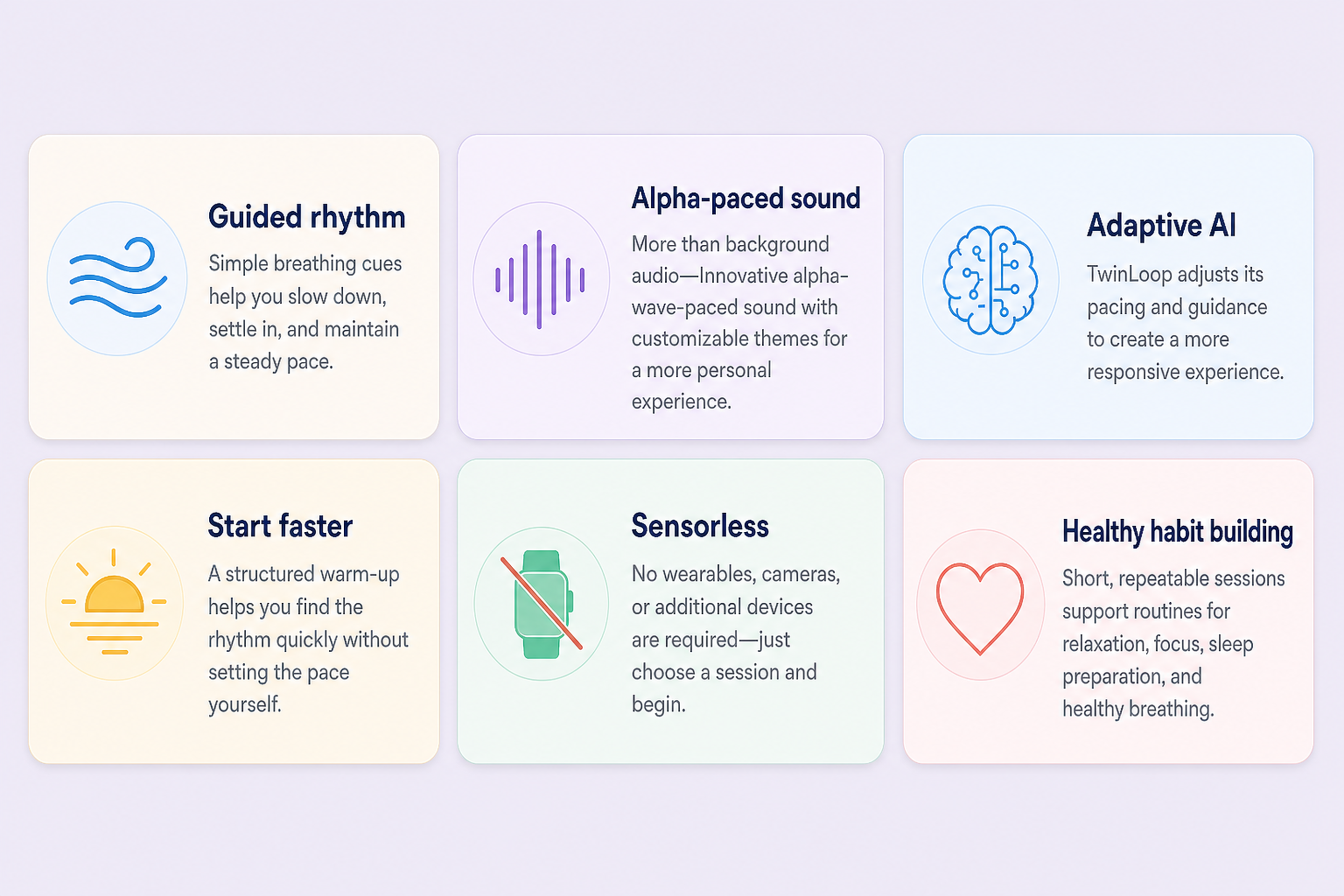
Twinloop uses a sensorless Personal Estimator to provide a personalized starting breathing profile. The estimator is intended to select a practical initial pace rather than declare a medically optimal or clinically measured breathing rate.
The distinction is important. A formal cardiorespiratory resonance-frequency assessment uses physiological signals such as ECG, pulse, and respiration while testing several candidate breathing rates. Twinloop's Personal Estimator does not perform that measurement and should not be interpreted as a clinical resonance-frequency test.
The estimator instead uses personal information to provide an individualized starting point that can be explored without EEG or a wearable.
Twinloop combines personalized paced breathing with alpha-guided sound in guided sessions designed around sleep wind-down, calm, focus, and blood-pressure support.
From a Universal Formula to an Individualized Starting Rhythm
The available evidence supports several conclusions.
4-7-8 breathing can be a useful relaxation technique. Slow breathing more broadly has substantial evidence for influencing HRV and autonomic cardiac regulation. Breathing near six breaths per minute can produce strong HRV responses in many adults. Cardiorespiratory resonance can also vary among individuals.
At the same time, current research does not establish one breathing formula as universally best, and it does not yet prove that personalized breathing produces superior outcomes in every setting.
The scientifically defensible direction is therefore not to reject fixed techniques. It is to recognize their value while continuing to investigate whether breathing guidance can become more individualized.
Twinloop is designed around that principle: use scientific evidence to provide a personalized starting rhythm rather than assume that one fixed formula fits everyone.
Try the free Twinloop Personal Estimator:
https://twinloop.io/alpha-estimator
Scientific References
-
Marchant J, Khazan I, Cressman M, Steffen P. Comparing the Effects of Square, 4-7-8, and 6 Breaths-per-Minute Breathing Conditions on Heart Rate Variability, CO2 Levels, and Mood. Applied Psychophysiology and Biofeedback. 2025;50(2):261-276.
https://pubmed.ncbi.nlm.nih.gov/39864026/ -
Kurt Aktaş G, Eskici İlgin V. The Effect of Deep Breathing Exercise and 4-7-8 Breathing Techniques Applied to Patients After Bariatric Surgery on Anxiety and Quality of Life. Obesity Surgery. 2023;33(3):920-929.
https://pubmed.ncbi.nlm.nih.gov/36480101/ -
Laborde S, Allen MS, Borges U, et al. Effects of voluntary slow breathing on heart rate and heart rate variability: A systematic review and a meta-analysis. Neuroscience & Biobehavioral Reviews. 2022;138:104711.
https://pubmed.ncbi.nlm.nih.gov/35623448/ -
Shaffer F, Meehan ZM. A Practical Guide to Resonance Frequency Assessment for Heart Rate Variability Biofeedback. Frontiers in Neuroscience. 2020;14:570400.
https://pmc.ncbi.nlm.nih.gov/articles/PMC7578229/ -
Sumińska S, Rynkiewicz A, Szulczewski M. Resonance frequency versus fixed 0.1 Hz breathing in HRV biofeedback: a four-week randomized comparison. Scientific Reports. 2026;16:22630.
https://www.nature.com/articles/s41598-026-53333-6
About Twinloop Innovations
Twinloop Innovations develops science-informed digital wellness technologies designed to support calm, sleep, blood pressure support, and broader guided training experiences. Learn more at www.twinloop.io and read company updates at www.twinloop.io/news.
Disclaimer: Twinloop products and content are provided for general wellness and informational purposes only and are not a substitute for professional medical advice, diagnosis, or treatment. Users should consult a qualified healthcare professional regarding any medical concerns or decisions.